Say What You Meant
You speak English. But when it matters, the right words come too late, or don't come at all. This is a two-week sprint to find out exactly what keeps happening.
I'm in — $147 See how it works
It’s not a practice problem.It’s a feedback problem.
You've practiced. You've taken lessons. You understand almost everything you read and hear. And still, in a real conversation, the right words don't come when you need them.
The sentence comes out smaller than what you thought. You pause too long. You say the safe version instead of the one you had in mind. You know something is off, but you can't point to what it is.
Practicing more won't fix this. If speaking practice worked on its own, you'd already be where you want to be. What's missing isn't more attempts. It's someone listening carefully enough to name the specific thing that keeps breaking down.
Practicing without feedback is just repeating the same patterns more confidently.
This isn't speaking practice. This is finding the problem and starting to fix it.
AI tools give automated feedback. Someone actually listens to your specific recordings and names the patterns she keeps hearing across all four.
No rules. No corrections in real time. No scheduling a one-hour block and hoping the moment is convenient. You speak when you have three minutes.
No modules. No homework. Four voice messages over two weeks. A personal breakdown after each one. A written list of your patterns at the end.
What you walk away with
At the end of two weeks, you have three things you didn't have before.
A written breakdown of your specific patterns
Not "work on your vocabulary." Something concrete: the exact places where your English breaks down, written down, in your Telegram chat. You can read it again before a meeting that matters.
Clarity on where the problem actually lives
Two weeks is enough to know whether the problem is in your head (hesitation, self-editing, limiting yourself before you start) or in the language (vocabulary, structure, specific patterns). That distinction changes everything you do next.
Four recordings of yourself actually speaking
For most people at this level, that's already rare. Four times you spoke English deliberately, on a real topic, without preparing. That's a concrete thing you did — not a feeling, not an impression.
How it works
Two weeks. No calls. No lessons. Everything happens in a private Telegram chat.
You receive a prompt
One prompt arrives at a time — a real speaking moment, the kind where words usually slow down. Before your first message, you hear a short voice note from me so you know what "good enough" sounds like. No preparation needed.
You speak
Record a voice message of 2–3 minutes, whenever you have the time. No performing. No restarting until it sounds right. Imperfect, unfinished, real — that's exactly what we work with.
I listen and send written feedback
I quote the exact moment that broke down. I name what happened. I offer one or two clearer ways to say it. I note what's already working — one specific thing, not general praise. The feedback is written so it waits for you, not the other way around.
You listen once
No homework. No rewrites. No sending again. You read the feedback and notice what feels like: "Yes — that's it." If it comes back next time, it's yours.
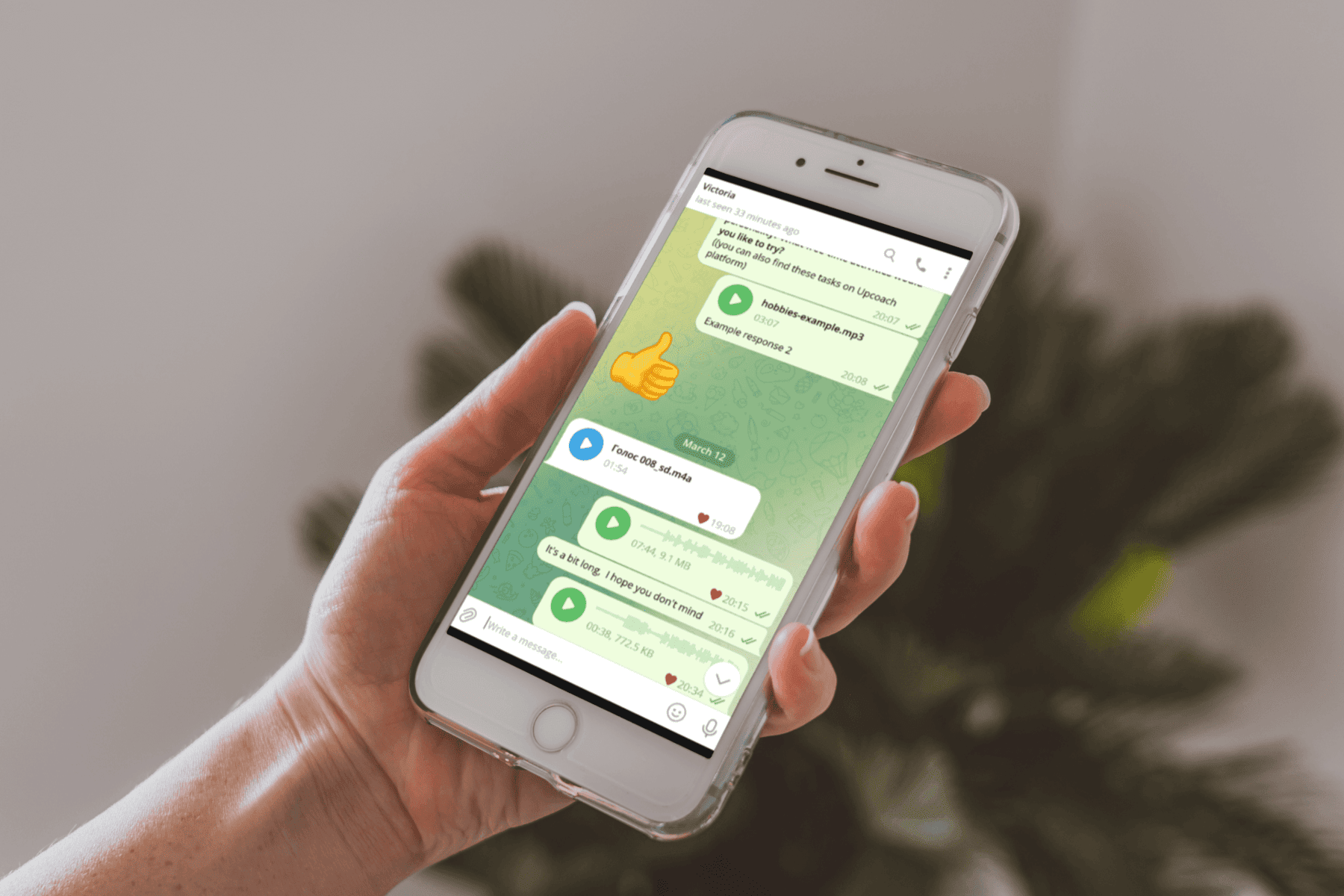
What the sprint looks like in your Telegram chat
The four prompts
Everyday moments. But also the ones where words slow down, even for confident speakers.
These aren't test questions. They're the kinds of moments where you usually reach for a safe sentence instead of the real one. That's what we listen for.

Who's listening
I'm Tetiana. I've been working with Ukrainian adult speakers for over 20 years, specifically with people who understand English well but can't use it naturally when it counts.
In the sprint, I'm not a teacher. I don't explain rules or correct every mistake. I notice. I name what's already working. I offer wording you can actually reuse. I show you what to keep.
After 20 years of working specifically with Ukrainian speakers, I can often see the shape of what someone is reaching for before they've found it. The Ukrainian thought is there. The English words for it haven't arrived yet.
Nobody has ever listened to you speak and told you: here is the exact pattern I kept hearing. That's what this is.
Questions people ask before buying
Is two weeks really enough to make a difference?
Two weeks won't fix your English. But it's enough to know whether the problem is in your head or in the language. Most people have a vague sense that something is off but can't point to what. They finish with a name for it. That's the thing that tells you what to work on next.
Why not just book two lessons with a teacher instead?
Live lessons are good for back-and-forth, instant reaction, real conversation. This is different. The feedback waits for you in writing, in your chat. You can read it again the night before a meeting. You don't have to find a one-hour slot that works for both of you. And what you get here is specifically about your patterns across four recordings — not corrections in the moment.
I don't speak much English day-to-day. Will I be able to do this?
This is designed for people who don't speak regularly. That's normal. That's exactly who this is for. If you usually read and listen to English rather than speak it, four prompted voice messages over two weeks might be the first time you've spoken deliberately and regularly. For some people that's already a huge difference in the right direction.
I've tried speaking practice before and nothing changed. Why would this be different?
Because this isn't speaking practice. It's finding out why speaking practice hasn't worked. The sprint doesn't add more attempts — it adds someone listening carefully for the specific reason the attempts aren't working.
Is it worth the price?
This isn't an app. A real person listens to every recording. AI tools give automated feedback at $10 a month — they've never heard you specifically and never will. What you're paying for is human attention focused entirely on your particular patterns, delivered in writing, in two weeks.
Is this for you?
This is for you if
- You already speak English but the words don't come fast enough when it matters
- You've practiced but nothing seems to move
- You don't know what specifically keeps going wrong
- You can't commit to regular scheduled lessons right now
- You rarely speak English and want to start — carefully, with feedback
- You want something concrete to walk away with, not a general impression
This is not for you if
- You're a beginner and need basic grammar first
- You're looking for live conversation and instant back-and-forth
- You want a structured course with modules and progress tracking
- You expect fluency in two weeks
Practical details
Two weeks. One price.
Four prompts. Four rounds of personal feedback. Written breakdown of your specific patterns.
1-on-1 · Async · No calls · No homework
You'll be redirected to a short form to confirm your start date.