You’re telling someone about a film you watched last weekend. You know exactly what you thought. You can picture the scene. But when you open your mouth, what comes out is:
“It was really interesting. I liked it.”
Not because your opinion was simple. Because the words weren’t there fast enough.
One of my students was telling me about Mavka. She had a clear opinion — she wanted to say the plot was simple but the story was beautiful.
What came out was:
“The сюжет of the movie is very simple.”
She knew what she meant. The English word just wasn’t there.
Another student was describing House of Paper. She remembered the whole story clearly: a group decides to rob the place where money is printed, they have multiple backup plans, it’s tense the whole way through.
What came out was:
“It’s a band that decided to rob… a monetary house, where the money is created.”
The idea was completely there. The words (heist, gang, mint) weren’t.
That’s the gap this post is for — not learning movie vocabulary from scratch, but having it ready when the conversation is actually happening.
If you want to understand why this happens (why words you know don’t come when you need them), this post on turning passive vocabulary into active explains exactly what’s going on.
The vocabulary you’ll actually use
These are the ones students reach for and miss most often. Read through them once, then try using one the next time someone asks what you’ve been watching.
| Word or phrase | What it means |
|---|---|
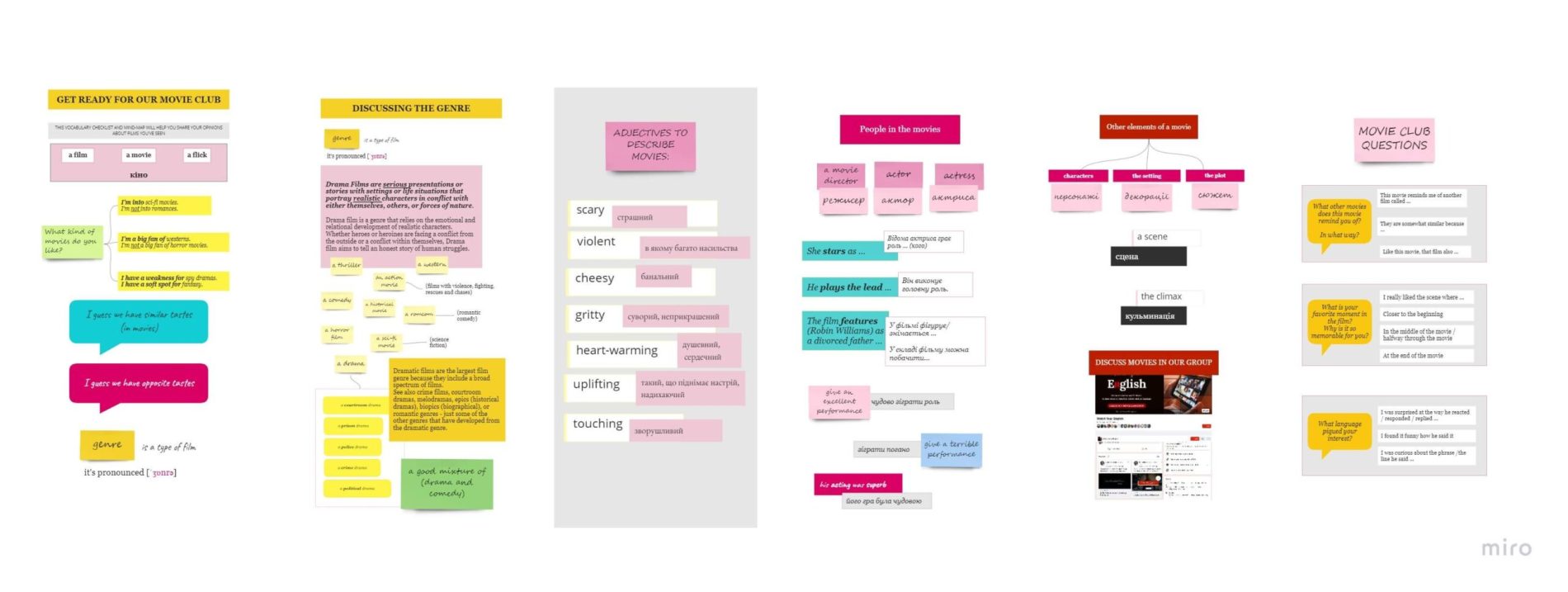
| plot | The sequence of events in the film — what happens and in what order |
| plot twist | An unexpected change in the story that surprises the audience |
| storyline | Similar to plot, but often used for a specific thread within the film |
| the setting | The time and place where the story happens |
| a scene | A single continuous moment in the film, in one location |
| the climax | The most intense moment — usually where everything comes to a head |
| character | A person in the story (not the actor — the role they play) |
| the lead / the main character | The central character the story follows |
| director | The person who makes the creative decisions for the film |
| give an excellent performance | Describe acting that impressed you |
| … stars as … | [Actor] stars as [character name] |
| … plays the lead | The actor has the main role |
| a heist | A robbery — usually planned, often elaborate |
| a gang / a crew | A group of people working together, often on something illegal |
| a mint | The place where money is physically printed |
| a backup plan / plan B | An alternative plan in case the first one fails |
| a season / an episode | A full run of episodes / a single instalment of a series |
| a miniseries | A short series with a limited, fixed number of episodes |
| it runs for [x] episodes | The series has [x] episodes total |
| I remember the overall idea but not the details | Useful when you’ve seen something but can’t recall everything |
Words to describe how the film felt
Knowing genre names isn’t enough. These adjectives are what let you say something specific about your reaction.
| Word | What it means |
|---|---|
| gripping | You couldn’t stop watching — it held your attention completely |
| thought-provoking | It made you think, even after it ended |
| slow-paced | The film moved slowly — could be intentional or frustrating, depending on your taste |
| fast-paced | Events moved quickly, lots happening |
| predictable | You saw it coming — no surprises |
| heart-warming | Emotionally positive, left you feeling good |
| unsettling | Made you uncomfortable in a way that stayed with you |
| cheesy | Clichéd, a little too easy — often used affectionately |
| gritty | Raw and realistic, not polished or comfortable |
| uplifting | Gave you a sense of hope or possibility |
| touching | Emotionally moving — made you feel something |
| I was really invested in the characters | You cared about what happened to them |
| I had mixed feelings about it | You’re not sure whether you liked it or not |
| it left me with a strange feeling | Hard to explain, but something stayed with you |
Genre names worth knowing
| Genre | What it is |
|---|---|
| thriller | Suspense, tension, unexpected twists |
| action movie | Fights, chases, physical intensity |
| drama | Emotional and personal conflicts, realistic situations |
| comedy | Focused on humor |
| romcom (romantic comedy) | Romance and humor combined |
| horror film | Designed to create fear |
| sci-fi | Futuristic, speculative, often involves technology or space |
| mystery | A puzzle to solve — something is hidden or unknown |
| historical movie | Set in a specific historical period |
| western | American Old West — cowboys, frontier life |
| a good mixture of drama and comedy | Exactly what it sounds like |
How to recommend a film
(without saying “I suggest to watch it”)
This is where Ukrainian speakers almost always get stuck. The construction suggest to + verb doesn’t work in English. Here’s what does:
- I’d recommend it.
- It’s worth watching.
- I suggest watching it. (suggest + gerund, not infinitive)
- I highly recommend it if you like slow-burn stories.
- Don’t watch it if you’re expecting a lot of action — it’s very dialogue-heavy.
- It’s not for everyone, but I loved it.
- I’d recommend it to almost anyone.
That last group is more useful than a simple recommendation — it gives the other person information to make their own decision, which is what natural conversation actually sounds like.
Finding the right words mid-sentence is a different problem from not knowing them at all. If that moment of reaching and not finding is familiar, this is about exactly that: How to Keep Talking When the Word Won’t Come
Try this before your next conversation
Pick one question. Answer it out loud — in English, alone, right now — using at least one word from this post you wouldn’t normally reach for.
- What’s the last movie or series you genuinely enjoyed?
- What kind of movies do you usually avoid?
- Do you prefer movies that make you think or movies that help you relax?
- What’s a movie everyone seems to love but you didn’t enjoy?
- Have you ever rewatched a series years later? Did it feel different?
- What makes you continue watching a series after the first episode?
- Do you usually binge-watch or watch slowly?
- What’s more important for you: the plot, the characters, or the atmosphere?
- Have you ever stopped watching something even though everyone recommended it?
- Which movie character felt especially realistic to you?
One question. One answer. Out loud.
That’s the difference between a vocabulary list you’ve read and vocabulary you’ve actually used.
If this kind of thing is useful — specific language, real gaps, what actually gets in the way when you speak — my newsletter is where I write about it regularly. No lessons, no tips lists. Just honest writing about spoken English for people who already know a lot but want to use it better.
Sound More Like Yourself in English