There’s a counterintuitive way to improve speaking by writing. Most people think you need to speak more. Practice conversations. Do speaking exercises. But there’s something else that works, and most learners never discover it: noticing what natural phrasing actually looks like on paper, then saying it aloud until it sticks.
One of my students brought an email to class. She’d drafted it to her manager Henrik about a bottleneck in the project — something outside her control that was going to shift the timeline. She had to flag it.
The email she drafted was:
“Hi Henrik, I want to inform you about one situation that happened. The approval process took longer than expected. I think it is important that we discuss this topic because it impacts the project. The legal team also need more time to review everything before we can proceed. I am very sorry for this inconvenience. Can we adjust the deadline?”
It didn’t sound like her. Too much apologizing. Too much softening a problem that wasn’t her problem.
We rewrote it together. I showed her the better phrasing:
- “I wanted to flag a bottleneck in our timeline.”
- “The approval process took longer than expected, which affects our deadline.”
- “We’ll need to adjust the deadline to accommodate this.”
- “Here’s what I recommend we do next.”
She understood why each one worked. We talked through the shift — from apologizing to stating the issue clearly.
Then I asked her to explain why this mattered to Henrik. As she talked, the same words came back. Not paraphrased. The actual phrasing from the email: “one situation that happened,” “I am very sorry,” “before we can proceed.”
Her brain had stored the original pattern, not the improved one.
Why writing helps you notice
When you write, you have time. You can reread. You can see two versions next to each other. You notice what sounds natural. That noticing is where the learning happens.
But it only works if your brain uses it when you speak. If you don’t, you default back to the old pattern. The one that feels safe.
How ChatGPT can show you what natural looks like
You can use ChatGPT to mirror your writing back so you can see what works and what doesn’t. Not to write for you. But to show you what natural sounds like.
Here are three prompts:
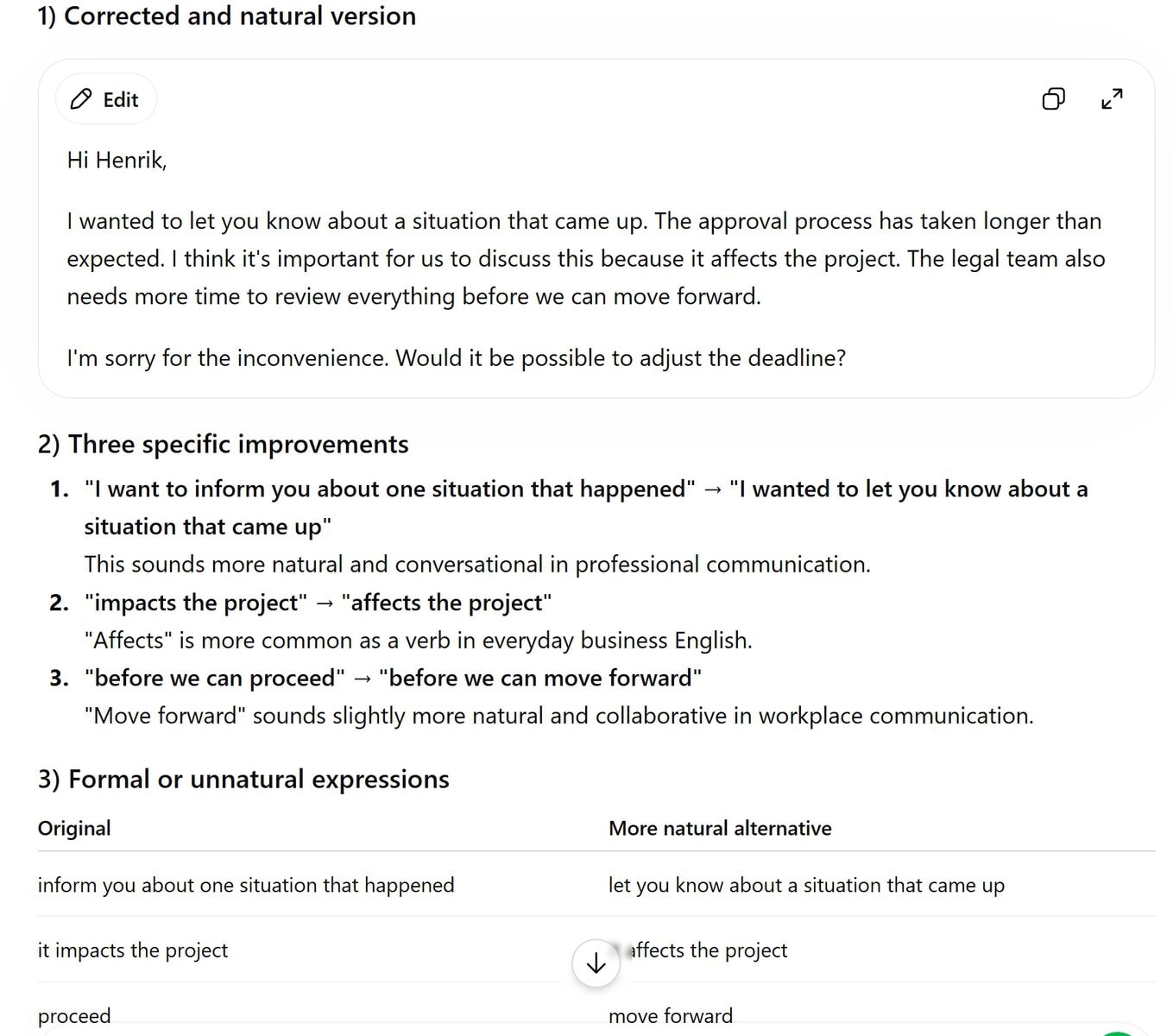
Prompt 1: Get feedback and explanations
Review the text I paste for grammar and natural phrasing, as if you are coaching a non-native English speaker. Please do the following: 1) Correct the grammar and give a single natural-sounding rewritten version. 2) Suggest 3 specific improvements (word choice, sentence flow, or tone) and give a short explanation for each — one sentence per explanation. 3) Mark any expressions that are too formal or unnatural and give a simple natural alternative. 4) Give one short example sentence showing a more natural way to say the same idea.
[Paste your draft here]
You get: your mistakes plus explanations. You understand why each change matters.
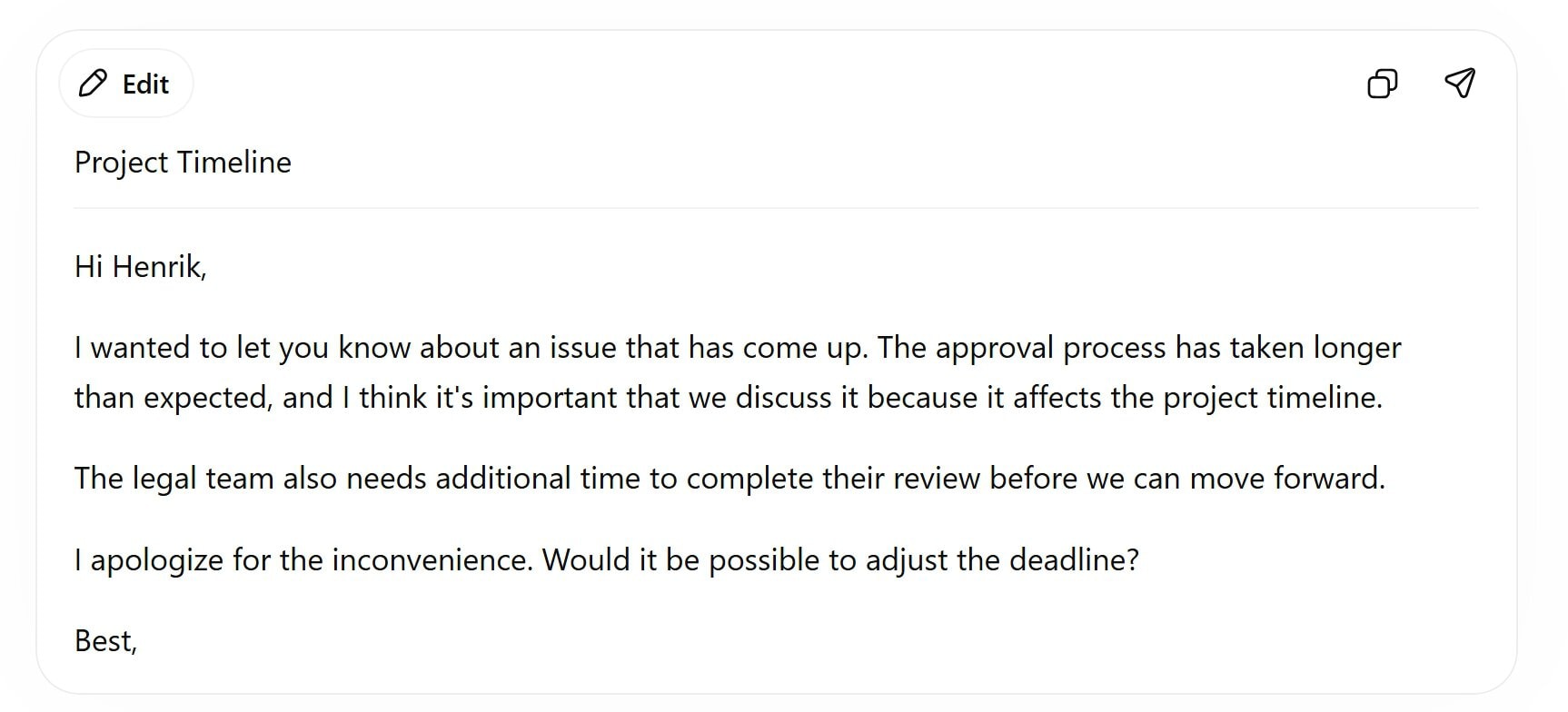
Prompt 2: Just see the rewritten version
Rewrite the text I paste into a brief professional email to a colleague that sounds like a native speaker. Address the recipient by name, open with a short purpose sentence, state the problem clearly, give one concise recommended next step or options, ask for a brief meeting or confirmation, and close with a short sign‑off and sender name. Use precise, direct language; avoid hedging and unnecessary apologies; use contractions if the tone is casual or friendly. Keep the email 4–7 short lines. [Paste your draft here]
You get: what natural looks like without the analysis. Sometimes that’s all you need.

Prompt 3: Change tone to casual English
Rewrite the text below in a casual, friendly tone. Keep the original meaning and important details. Only show the rewritten version. [Paste your text here]
You get: the same idea sounding different depending on how you frame it.
The actual loop that works
After you’ve seen the improved version, read it aloud. Don’t just read with your eyes — say the words. Listen to how it sounds.
Then use one phrase tomorrow in real conversation.
That’s the loop:
Write → Notice → Say it → Use it → Your brain stores the new pattern.
What to do right now
What do you need to say in English right now — at work, to a client, in a meeting?
- Write it down
- Paste it into ChatGPT
- Read the improved version aloud
- Steal one phrase
- Use it tomorrow
Want tips on how to notice and use the English you’re trying to steal? Subscribe to “Thinking in English”:
Sound More Like Yourself in English