One of my students watched Friends all the way through. Twice. In English, with English subtitles.
Her listening got better. Her vocabulary grew. And when she spoke, she still reached for the same ten words she always used.
This is the movies problem. Not that they don’t work — they do. But not automatically, and not in the way most people expect.
What watching movies in English actually gives you
Movies give you real language: real conversations, real rhythm, real phrasing. You hear how people actually talk — not the clean version from a textbook, but the fast, interrupted, emotionally loaded version.
That matters. Especially if most of your English comes from reading or structured lessons. Movies remind your ear what the language sounds like when it’s alive.
But here’s where it stops.
Watching gives you recognition, not production. You can follow a conversation without being able to have one. You can understand a phrase without it being available when you speak.
The gap between what you understand and what you can say is not closed by more watching. If you want to understand why that gap exists and how to close it, this post goes deeper: Turn Passive Vocabulary Into Active.
How to watch English movies differently
The goal isn’t to study the movie. It’s to notice specific moments and do something small with them.
Use subtitles strategically. Some teachers say avoid them entirely. I don’t agree. Subtitles help you catch the exact wording of something you half-heard — and exact wording is what you need if you want to use a phrase yourself.
One approach: try to catch what’s being said first, then glance at the subtitle to confirm. You’re training yourself to listen first, not read first.
Write down phrases, not single words. A single word is easy to look up and easy to forget. What’s harder to find — and more useful — is the full phrase: how the word is used, what it connects to, what the speaker was trying to do. There’s more on why single words often don’t stick here: The Real Reason Your Vocabulary Isn’t Working.
For example, you probably know the word mention. But would you think to say since you mentioned it — the way someone uses it to smoothly bring something back into a conversation? That’s the difference between knowing a word and having it ready when you speak.
That’s the version that helps you speak.
Say it out loud once. Put yourself in the scene. If the character was annoyed, be annoyed when you say it. Not because it’s more fun, but because emotion helps a phrase come back faster when you need it.
You don’t need to do this with every phrase. One phrase, done properly, is worth more than a list of twenty.
What to pay attention to when you watch movies
Not every line. You’ll exhaust yourself trying to catch everything.
Instead, pause when you notice one of these:
A word or phrase you know when you hear it, but would never think to say yourself. You understand it completely — but it would never come out of your mouth. That gap is exactly what this kind of watching is for.
A reaction that feels different from how you’d respond in Ukrainian. The way someone says no without apologizing. The way someone ends a difficult conversation. The way someone expresses surprise, or excitement, or disagreement — and it sounds completely natural in English but wouldn’t translate directly. Those moments show you something about the language that grammar lessons don’t.
A phrase that handles a situation you recognize — but in a way you wouldn’t have thought of. In Ukrainian you might say що ти маєш на увазі? In English, a character says What’s that supposed to mean? — and it carries a completely different tone. Same situation, different language, different effect. Those moments are worth stopping for.
One or two of these per film is enough. Notice it, write it down, say it once. That’s the method. And if you want to practice what happens when the word still doesn’t come in a real conversation: How to Keep Talking When the Word Won’t Come.
When to pause and when to keep watching
You don’t need to stop every time you don’t understand something.
If you’re missing individual words but still following the story — keep watching. Context will often fill the gap, and stopping too often breaks the experience.
Pause when you lose the thread completely, or when something catches your attention and you want to keep it. Look it up, write it down, move on.
One practical signal: if you’re pausing more than once every five minutes, the film is probably too difficult for this kind of watching. Save it for later, or just watch it for pleasure without trying to take anything away from it.
How to choose a film for your level
The right film is one where you can follow what’s happening without constantly rewinding. Beyond that, four things make a real difference: how fast people speak, how clear the accent is, how much actual dialogue there is, and whether the situations feel close to your own life.
A film with long action sequences and little conversation gives you less to work with. A workplace drama, an everyday comedy, a relationship story — those are closer to the English you actually need.
If you want help choosing, FilFluent lists films and TV shows by CEFR level. Community-rated, not official — but useful.
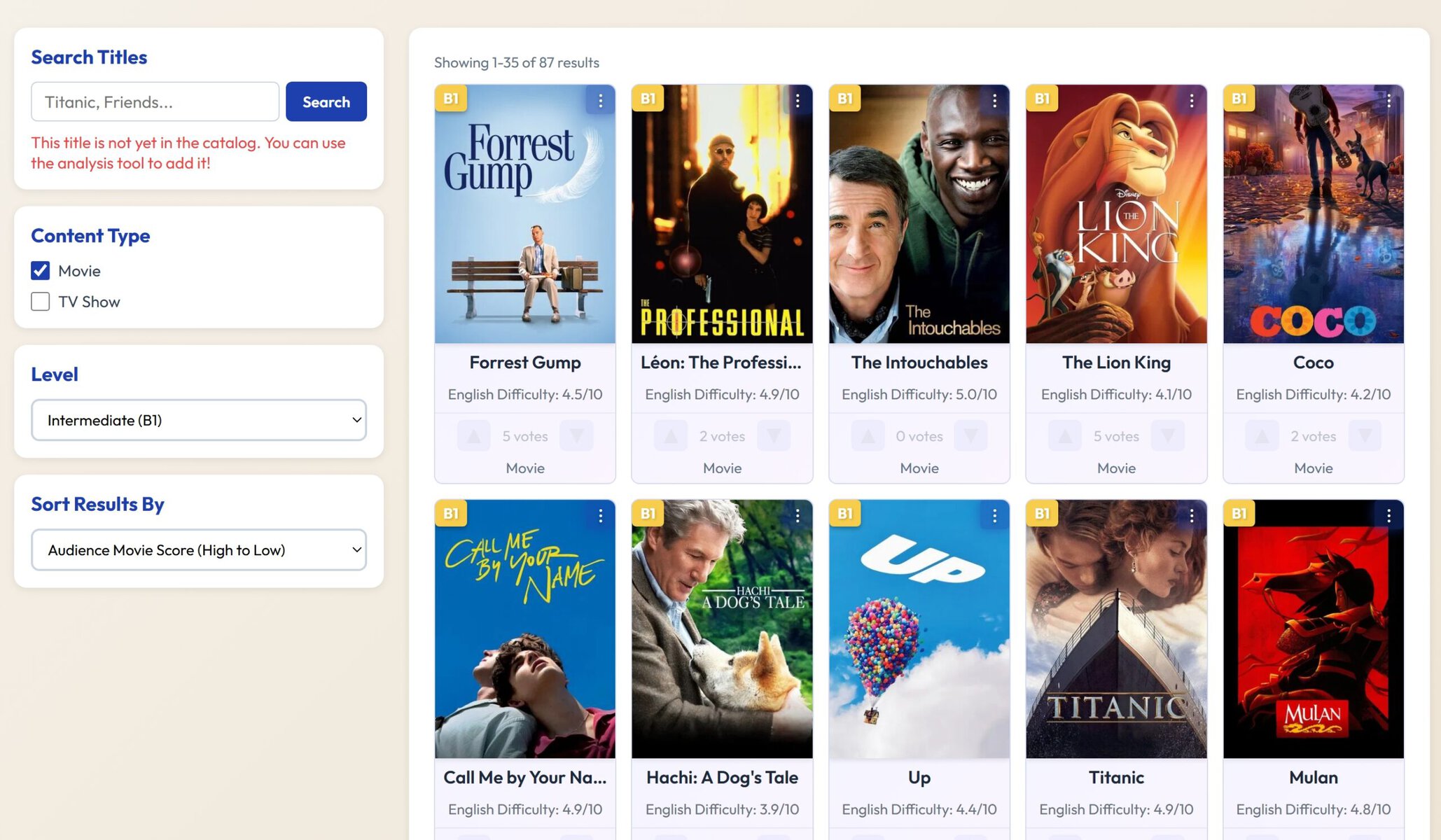
Films worth starting with at B1–B2
- Dawn of the Planet of the Apes — the slowest speech of 150 top-grossing films studied; very accessible vocabulary. A good first choice if you want to catch every line.
- The Devil Wears Prada — workplace English at its most usable: requests, pressure, professional small talk. Fast in places, but the phrasing is sharp and worth catching.
- Julie & Julia — relaxed pace, everyday situations, a lot of emotional variety without complex vocabulary.
- Legally Blonde — light and fun, but full of natural spoken American English, including how people argue and negotiate.
- The Crown — slow, deliberate delivery and very clear British pronunciation. Formal register, but easy to follow word for word.
Ready for harder: The Social Network, The Pursuit of Happyness, Marriage Story.
The movie journal: a place to put what you noticed
Writing about a film after you watch is not extra homework. It’s where the language moves from passive to active.
When you write down how a character made you feel, you have to find words for that in English. When you write a short review, you have to form and express an opinion. When you write down a phrase you want to remember, you make it easier to find it again.
I have a free movie journal template for this — a short PDF with prompts for each of these things: the characters, the emotions the film gave you, a short review in your own words, and a page for three phrases you want to keep. It takes about five minutes to fill in after watching, and it turns a passive experience into something you can actually use.
Download the movie journal — free PDF
How often should you watch?
There’s no single answer here. It depends on whether you enjoy films at all, and whether you’re the kind of person who can switch into “I’ll notice something” mode after you’ve just finished enjoying a story.
Some people watch one film a week and naturally pay attention. Others watch ten films and don’t take anything away. The number isn’t the point.
What matters is the five minutes after. If you do something small with what you noticed — write it down, say it out loud, use it once in a conversation — one film a month is enough to move something forward. If you just watch and move on, ten films won’t change how you speak.
Speaking breaks down in moments that have nothing to do with movies — mid-sentence, under pressure, when it actually matters. My newsletter covers those moments: what goes wrong, why, and what to do about it. If that sounds useful, you can sign up below. It’s free and comes out weekly.
Sound More Like Yourself in English