A student once told me she’d been watching English TV shows for three years. Crime dramas, mostly. She understood almost everything — the dialogue, the jokes, the courtroom arguments. Her listening was genuinely good.
Then I asked her to describe the last episode she’d watched.
She paused. Started a sentence, stopped. Said “it was interesting” and looked at me apologetically, as if she knew that wasn’t quite it.
Three years of watching. And when it came to saying something about what she’d seen, the words weren’t there.
Watching Builds Passive Vocabulary. That’s Not the Same as Speaking.
Watching films and TV shows in English does something real. It builds your passive vocabulary — the words and phrases you recognize when you hear them. And passive vocabulary matters: if you can’t follow what someone is saying, you can’t respond. It’s the foundation everything else sits on.
But recognizing a word and producing it yourself are two completely different things. Your brain processes them differently. One is reception, the other is retrieval under pressure — and years of watching will train the first without touching the second.
This is why so many people at B1–B2 level feel stuck in a strange place: their listening is fine, their reading is fine, but the moment they have to speak, something stalls. The words they’ve heard hundreds of times simply don’t show up.
Watching fills the reservoir. Speaking is what draws from it. And you can’t train drawing by doing more filling.
You Don’t Need to Understand Everything
Before getting to what actually helps, there’s one thing worth naming directly: the expectation that you should understand everything is what stops most people from watching at all.
I’ve been teaching English for over 20 years and I still miss things in certain British shows with heavy Scottish or Irish accents. I don’t follow everything in Billions — not because my English is weak, but because some of it requires a background in finance I simply don’t have. Native speakers leave comments under shows asking for subtitles because Tom Hardy is hard to understand.
Shows are made for native speakers. It’s entirely normal that a B1 learner won’t catch everything, and a C1 learner will miss things too. That’s not failure. That’s just how it works.
What matters isn’t understanding every word. It’s understanding enough to follow what’s happening, who wants what, and why. That threshold is much lower than most people think — and once you stop measuring yourself against 100%, watching becomes something you can actually do without dread.
When Passive Vocabulary Actually Becomes Active
Passive vocabulary doesn’t become active just by sitting in your head long enough. It becomes active when the right context appears — when you need a word, it’s close to the surface, and something in the situation calls it forward.
I noticed this during a project I did in 2022, interpreting for NATO military instructors. I had no military background. But I’d watched enough films that words like reconnaissance and zeroing were somewhere in my passive vocabulary — and when the context demanded them, they surfaced. I wasn’t searching. They just came.
That transfer doesn’t happen automatically for everyone, though. It happens faster when you’re actively doing something with what you’ve heard, rather than just absorbing it.
Which brings us to the part most people skip.
What Actually Moves the Needle
Watching passively — comfortable on the sofa, following the plot, maybe catching a phrase here and there — is better than nothing. But it’s not language learning. It’s entertainment. Both are fine, but they’re not the same thing.
The difference is what happens after the episode ends.
Most people close the laptop and move on. The phrases they heard disappear. The character they found interesting stays interesting but never becomes material. Nothing transfers.
What changes things is spending ten minutes doing something with what you watched. Not studying it. Not rewinding every line with a dictionary open. Just responding to it in English — writing down how the episode made you feel, whether you’d recommend it and why, what you thought of a character’s decision. The same things you’d say out loud to a friend.
This does a few things at once. It forces you to reach for words rather than just recognize them. It shows you — quickly and honestly — which parts of your vocabulary are actually available when you need them and which are just familiar. And it builds the habit of expressing opinions in English, which is exactly what stalls for most people in real conversations.
You don’t need to write perfectly. The point isn’t accuracy. It’s the reaching.
A Tool That Helps With This
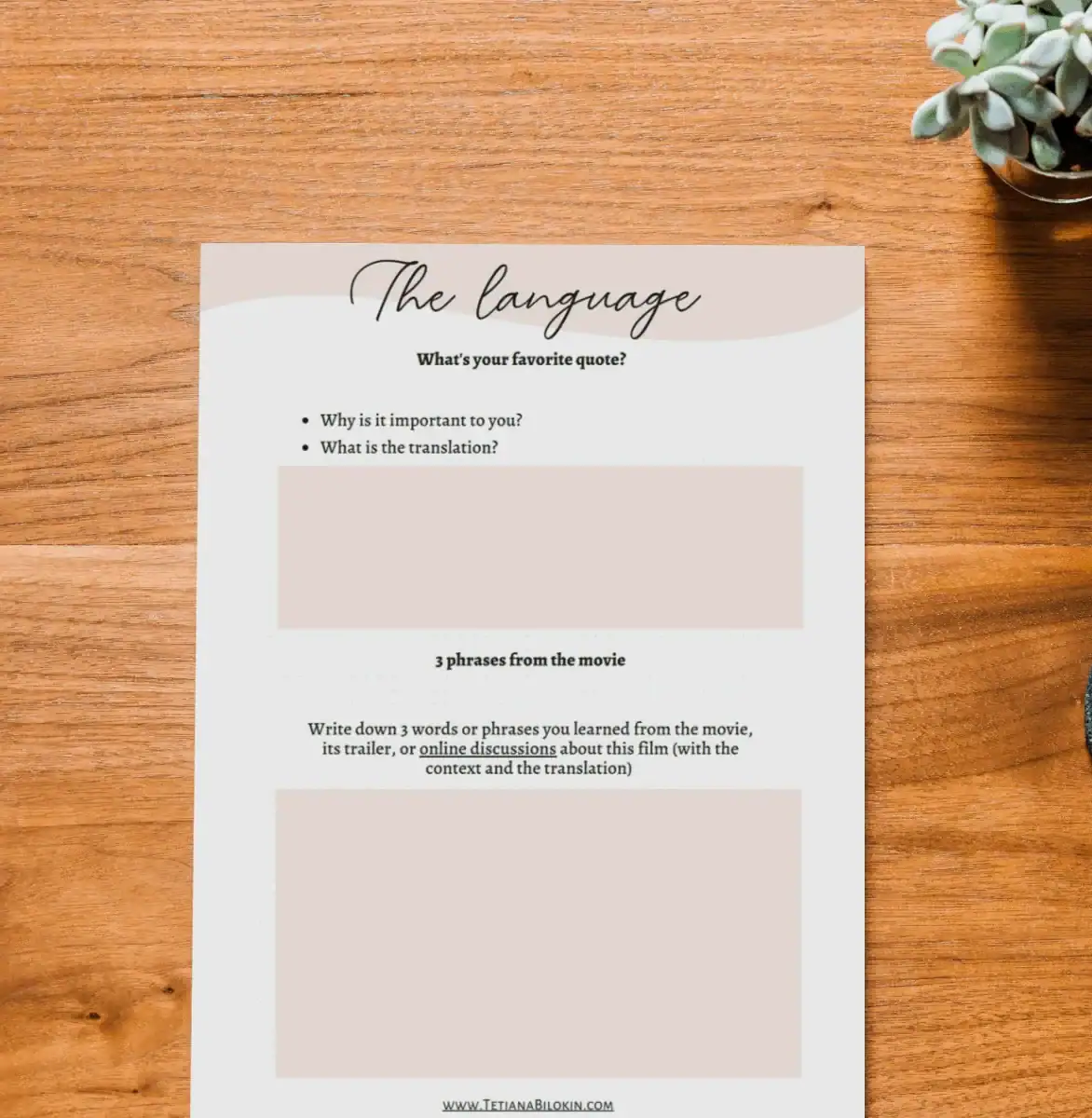
I made a simple Movie Journal template for exactly this purpose. It asks you to write the title, pick a genre, describe the main characters briefly, explain what the title means, say how the film made you feel, and decide whether you’d recommend it — and why or why not.
None of the questions are complicated. But answering them in English, after watching something you actually chose and enjoyed, is one of the more honest ways to find out where your active vocabulary actually is right now. And over time, the phrases you reach for in the journal start showing up in conversation.
You can get the template below. It’s free.
If you want to read more about how passive vocabulary transfers into speaking — and what else speeds that process up — this post goes into it through a specific experience that made it very clear to me: What I Learned Interpreting for Military Instructors